
The Plumeria Way
You watered your plumeria yesterday. Water ran from the bottom of the pot, so you gave it a good soaking. Or did you? Today the leaves are hanging, the pot feels light, and the center of the root ball is still dry. When potting mix dries and shrinks away from the sides of a container, water can run down the gap and straight out the drain holes. The hose reached the pot, but very little water reached the roots. Plumeria Care Guide on watering and moisture.
For a rooted, actively growing plumeria, underwatering begins when the roots can no longer replace the water the leaves are losing. The usual sequence is less available water → slower leaf expansion and loss of firmness → persistent wilt → leaf injury and shedding. Severe or prolonged drought can also kill fine roots. The stages overlap, and what you notice first depends partly on how quickly the plant dried out. Virginia Cooperative Extension · University of Kentucky Extension.
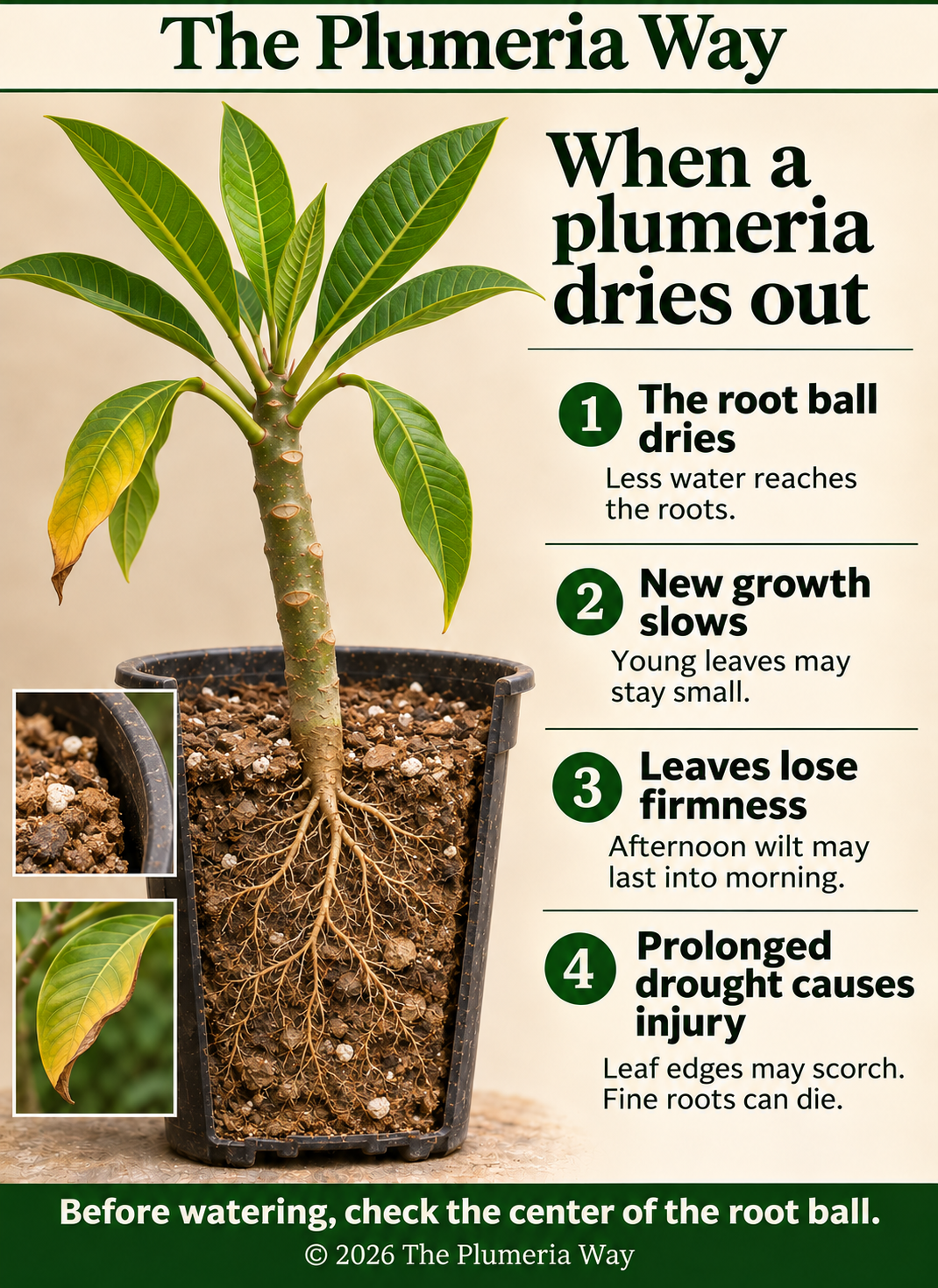
1. The root ball dries while the plant still looks healthy
A plumeria in full leaf can use water quickly during a stretch of sunny, windy weather. With each passing day, the roots draw from a smaller supply. The first clue in a container may be a change in weight. The pot feels unusually light, even though the leaves still stand at their normal angles. In the ground, the comparable check is moisture beneath the surface, where the roots are actually growing. A dry crust alone tells you little about the soil below it. Plumeria Care Guide on checking moisture at depth.
2. The newest leaf may slow down before the older leaves droop
Water pressure inside plant cells helps a young leaf unfold and expand. As water becomes harder to draw from the soil, that expansion can slow. Tiny pores in the leaves also begin to close, conserving water while limiting the carbon dioxide available for photosynthesis. On a plumeria that has been drying out repeatedly, look at the branch tips. The newest leaf may stay partly unfolded longer than usual, or several new leaves may open smaller than the ones below them. Virginia Cooperative Extension · Colorado State University Extension.
3. Leaves droop in the afternoon, then may lift overnight
On a hot afternoon, the broad leaf blades may hang lower or curl slightly as they lose firmness. Early on, they may lift again overnight because cooler conditions slow water loss and the remaining roots can catch up. If the dry period continues, the plant may still be wilted the next morning. That change is more informative than a single afternoon observation. Even a plumeria with moisture around its roots can droop briefly in extreme heat. University of Maryland Extension · University of Kentucky Extension.
4. Continued dehydration leaves lasting marks
As the shortage persists, leaf tips or margins may turn tan, then brown and crisp. Some older leaves may yellow and drop before they ever develop a brown edge. Shedding leaves reduces the amount of water the remaining canopy loses. On a plumeria, prolonged dehydration may also show as wrinkling along a still-firm stem. Read that sign alongside root-zone moisture and season. A soft or darkening stem base in wet mix points toward a different problem. Illinois Extension · Plumeria.Care on reading the stem.
5. Fine roots can die, and recovery takes longer
In a brief dry spell, living roots can resume supplying water once the root ball is evenly moist. After prolonged drought, some of the fine roots that absorb water may have died. That explains why a severely dehydrated plant can remain limp after you have watered it properly. Repeated soaking while the mix is already wet can add oxygen stress to a root system that is still recovering. With severe injury, a branch tip may die back. Colorado State University Extension · University of Kentucky Extension.
What to check before reaching for the hose
| What you find | What it suggests | What to do |
|---|---|---|
| The pot is light, the root ball is dry at depth, and an actively growing plumeria is drooping. | The roots have too little water available. | Water slowly and evenly, then let the excess drain. Check that moisture reached the center. |
| Water runs out immediately, but the pot barely gains weight and the center stays dry. | Water may be bypassing a shrunken root ball. | Apply water slowly in several passes, pausing for absorption. Recheck the center before deciding it has had enough. |
| Leaves droop during peak heat, the lower mix is still moist, and the leaves lift by morning. | Afternoon water loss temporarily exceeded uptake. | Check again in the cooler morning before changing the watering routine. |
| The pot is heavy, the lower mix is wet, and wilt persists. | The roots may be struggling to take up water in saturated soil. | Check drainage and stem-base firmness. If the plant keeps declining, inspect the roots. |
These checks are for established, leafy plants. A small seedling has a much smaller root system and can dry out sooner. A dormant, leafless plumeria uses less water, and an unrooted cutting cannot draw on the potting mix the way an established plant can. Each calls for a different watering decision. Plumeria Care Guide on watering by plant stage · Companion article: Why Plumeria Wilts in Wet Soil.
Watch the next morning and the next leaf. After a mild shortage, a drooping green leaf may regain firmness once water reaches functioning roots. A crisp brown edge is dead tissue and will stay brown. During active growth, a young leaf that resumes unfolding is a better sign of recovery. Virginia Cooperative Extension · Illinois Extension.
© 2026 The Plumeria Way